Protecting Children's Eyes from the Sun
Thanks to countless awareness campaigns and advice from dermatologists and media outlets like women's and family magazines, high-protection sunscreen is now used on children more than ever, often with SPF 30 or higher. But does the same level of care apply to eye protection?
While parents carefully strap their toddlers into helmets and TÜV-tested child seats when cycling and are generally very mindful of their safety, eye protection is often forgotten.
As common as sunscreen has become for kids, their eyes often still lack sufficient natural defenses and need just as much protection from the harmful effects of UV radiation. Eyes damaged by UV rays are more prone to conditions like cataracts, eye melanoma and corneal inflammation. So it's time to put your knowledge of proper eye protection to the test with a short quiz.

Do you know whether the following statements are true or false?
True or false: Children's eyes are especially sensitive to UV radiation.
TRUE!
UV radiation is more harmful to children's eyes than to adult eyes. Their eye lens contains fewer pigments and their pupils are larger. Too much sunlight can even cause permanent damage to children's eyes.
Babies in their first year of life have a clear lens that lets 90 % of UVA rays and 50 % of UVB rays through to the retina. The body's own protection builds up over the years, and it's only from around age 25 that the retina begins absorbing part of this radiation. On top of that, the blink reflex isn't fully developed in babies and toddlers yet, meaning the reflex to close their eyes at the right moment is barely there.
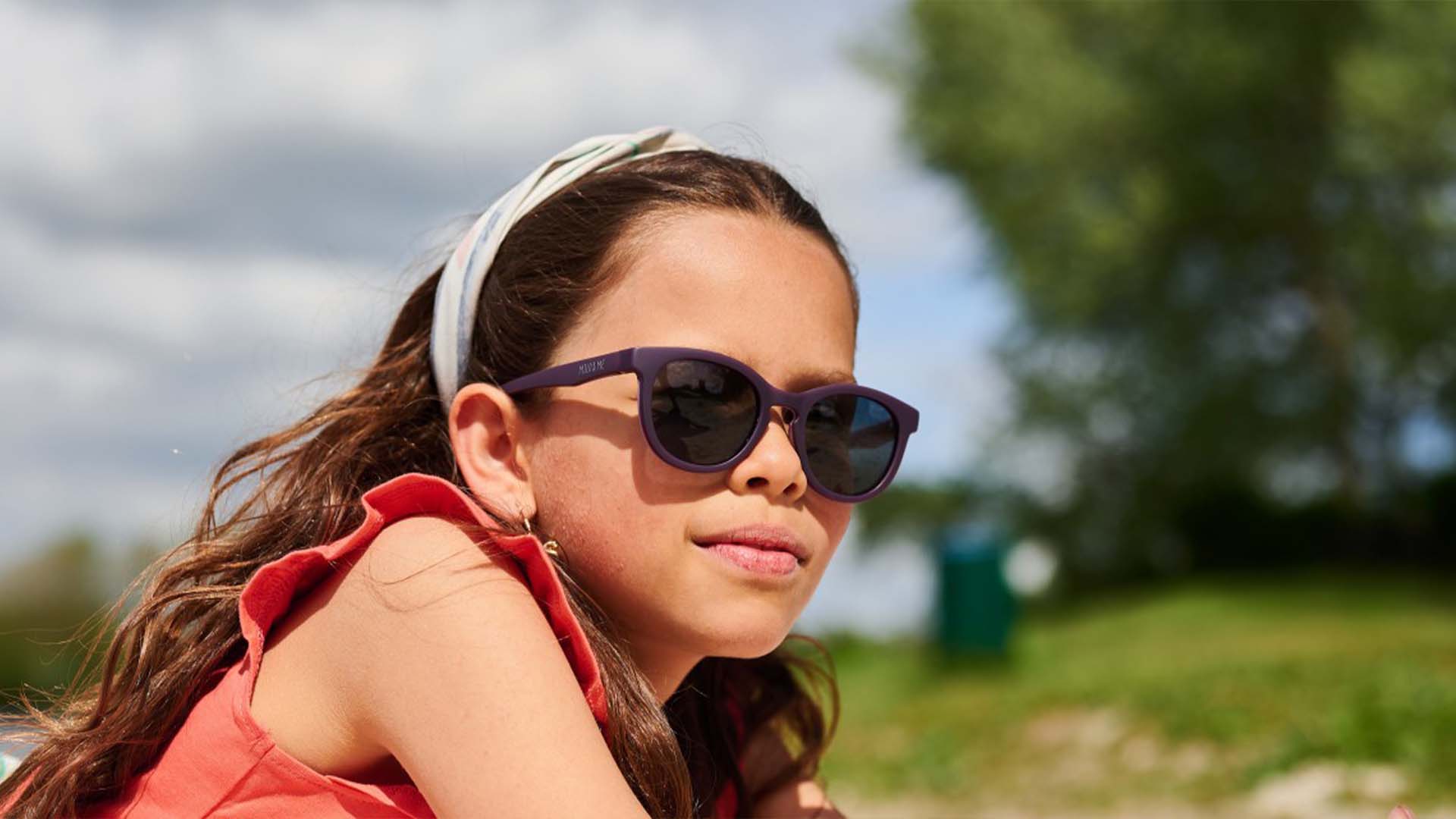
When children are very young, they're usually not exposed to direct sunlight and are shielded by an umbrella or the pram's canopy. But later, once little ones start walking and exploring the world on their own, the right pair of sunglasses becomes essential.
True or false: A hat or cap is enough sun protection for a child.
FALSE!
It's easy to assume that a cute sun hat or cap protects not just the head but the eyes too. In reality, that's only true to a very limited extent: harmful UV radiation still reaches the eyes through glare and reflections.
True or false: The darker the lenses, the better the UV protection.
FALSE!
How dark the lenses are says nothing about how well the sunglasses protect against UV radiation. In fact, even clear lenses can offer 100 % UV protection. Extremely dark lenses without UV protection are actually far more dangerous than lightly tinted lenses without UV protection, because darker lenses cause the pupil to widen, letting even more UV radiation in. So pay close attention to the sunglasses' UV protection rating and never rely on lens colour alone! The lenses or frame usually state what level of UV protection they offer. UV400 and UV100% both mean the sunglasses provide 100 % UV protection.
True or false: The higher the CE category, the better your eyes are protected from UV radiation.
FALSE!
The CE category confirms that the sunglasses meet European Union regulations, but it's the category number behind it that shows how much light the lenses actually absorb. That number indicates the level of glare reduction, not UV protection, and is usually found on the temple of the glasses. Category CE 1 absorbs between 20 % and 57 % of light, CE 2 between 57 % and 82 %, CE 3 between 82 % and 92 %, and category 4 lenses absorb up to 97 % of light. This last category offers maximum protection from glare and is best suited for the mountains or the sea. It can, however, sometimes be dangerous while driving: passing through a tunnel with them on, you'll barely be able to see anything at all.